
KEY TAKEAWAYS
- Generative engine optimisation (GEO) means making your content easy for AI assistants and AI search features to find, trust and cite.
- GEO does not replace SEO. Google states that the same fundamentals apply to its AI features: crawlable pages, helpful content and clear structure.
- The winners are pages that answer questions directly, show real expertise, use structured data and are mentioned across trusted sources.
In this guide
More and more people now ask ChatGPT, Gemini, Perplexity, Copilot or Claude for recommendations instead of scrolling through ten blue links. Google itself shows AI Overviews above traditional results for many searches and offers a conversational AI Mode. For businesses, this creates a new question: when an AI assistant answers a question in your industry, does it mention you?
Generative engine optimisation, usually shortened to GEO, is the practice of making your brand and content more likely to be understood, trusted and cited in those AI-generated answers. This guide explains how it works and what you can do today.
What is GEO?
GEO is the discipline of optimising content for generative AI systems that compose answers from multiple sources. Where traditional SEO aims for a ranking position, GEO aims for inclusion and citation inside the answer itself. You may also see the terms AEO (answer engine optimisation) and LLMO (large language model optimisation). They describe overlapping ideas.
How AI search chooses sources
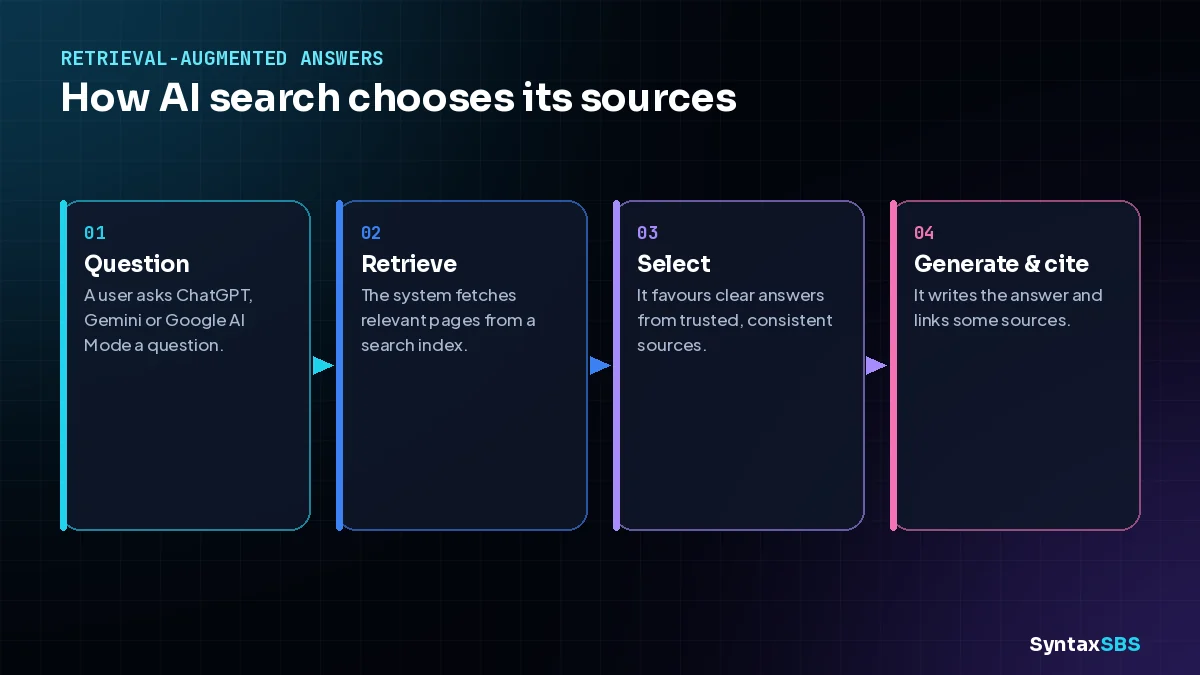
Different systems work differently, but most AI search features follow a similar pattern. The system interprets the question, retrieves relevant pages from a search index, then generates an answer and links to some of the sources it used. This is often called retrieval-augmented generation.
Two practical conclusions follow. First, if your page is not crawlable and indexed by the underlying search engine, it cannot be retrieved. Second, among the pages retrieved, AI systems favour passages that answer the question clearly, come from sources that look authoritative, and agree with other trusted sources.
GEO vs SEO
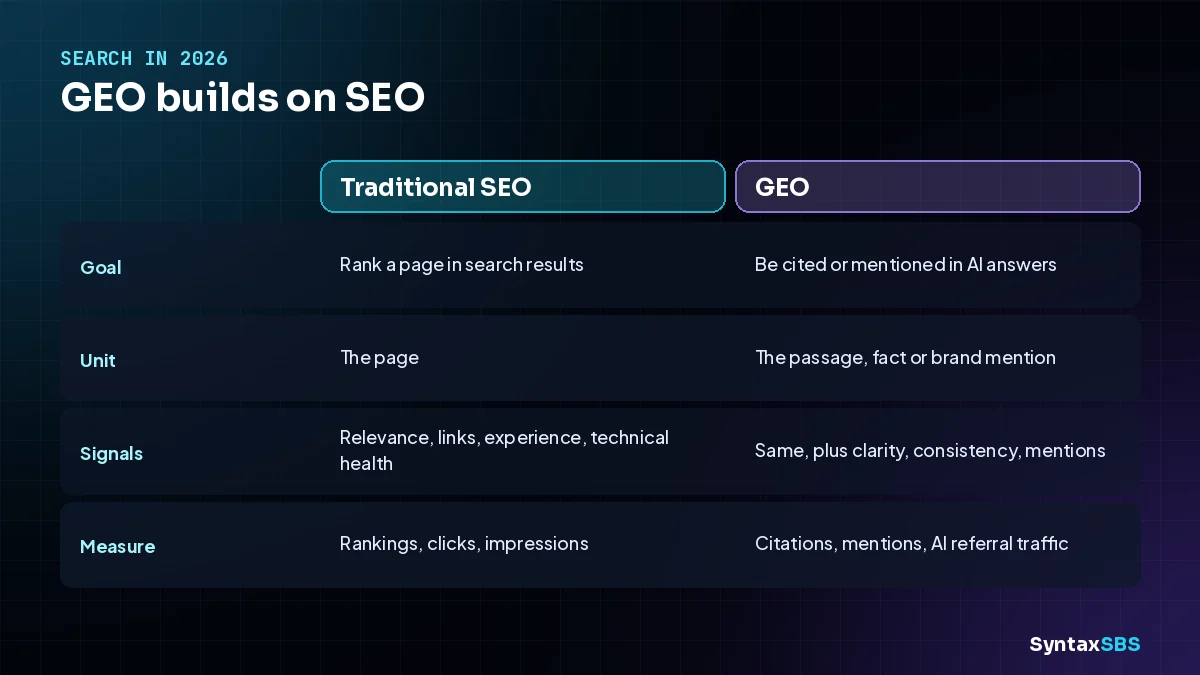
| Traditional SEO | GEO | |
|---|---|---|
| Goal | Rank a page in search results | Be cited or mentioned in AI answers |
| Unit of success | The page | The passage, fact or brand mention |
| Main signals | Relevance, links, experience, technical health | The same, plus clarity, consistency and brand mentions |
| Measurement | Rankings, clicks, impressions | Citations, mentions, referral traffic from AI tools |
The overlap is large. Google has said that there are no special requirements to appear in AI Overviews beyond its normal guidance on helpful, reliable content and technical accessibility. A technically healthy website is still the foundation. Our technical SEO audit checklist covers that groundwork.
Ten practical GEO tactics
1. Answer the question in the first two sentences
Put a direct, self-contained answer immediately under each heading, then expand. AI systems extract passages, and a clear opening sentence is far easier to quote than an answer buried in paragraph five.
2. Write headings as real questions
Use the language customers actually use, such as “How much does a penetration test cost?” Research these questions in Search Console queries, “People also ask” boxes, sales calls and support emails.
3. Add FAQ sections with structured data
Short question-and-answer blocks map naturally onto conversational queries. Mark them up with FAQPage schema so their structure is explicit to machines.
4. Use structured data across the site
Organization, Person, Service, Product, Article and BreadcrumbList schema help AI systems connect your brand, your experts and your offers. Consistent entity information reduces the chance of being misdescribed.
5. Show real experience and named experts
Attribute content to real authors with credentials, link to their profiles, and include first-hand data, screenshots and case studies. Original evidence is something an AI cannot find anywhere else, which makes your page worth citing.
6. Publish original data and clear facts
Statistics, benchmarks, pricing ranges and comparison tables are among the most cited types of content. Keep them accurate, dated and easy to extract.
7. Build topical depth, not single pages
Cover a subject thoroughly with a pillar page and supporting articles linked together. Depth signals expertise to both search engines and AI systems.
8. Earn mentions on trusted third-party sites
AI answers often reflect what many sources agree on. Being mentioned in industry publications, directories, reviews, podcasts and community discussions strengthens how AI systems describe your brand, even when those mentions are not links.
9. Keep content fresh
Update key pages when prices, laws, tools or statistics change, and show the last-updated date. Outdated facts are a reason for a system to prefer another source.
10. Make sure AI crawlers are not blocked by accident
Check your robots.txt and firewall rules. Some security tools block AI crawlers by default. Decide deliberately which crawlers you allow, balancing visibility against how you want your content used.
How to measure AI visibility
- Referral traffic: in Google Analytics 4, look for sessions referred by AI tools such as chatgpt.com, perplexity.ai, gemini.google.com and copilot.microsoft.com.
- Manual prompt tests: keep a list of twenty to fifty important questions, ask them in the major assistants every month and record whether your brand appears.
- Search Console: AI Overviews and AI Mode traffic is reported within your overall Search performance data, so watch trends in impressions and clicks for question-style queries.
- Dedicated tools: several SEO platforms now offer AI visibility tracking. Treat their numbers as directional, because AI answers vary between users and sessions.
Myths to ignore
- “SEO is dead.” AI search depends on search indexes. Strong SEO is still the entry ticket.
- “You need special AI markup.” There is no secret tag. Proposals such as an llms.txt file exist, but major search engines have not confirmed using them for ranking or citation.
- “Write for robots.” Content stuffed with keywords or written only for machines is less helpful and less likely to be trusted.
- “Mass-produce AI content.” Large volumes of thin, unoriginal pages are a risk under Google’s spam policies and add nothing worth citing.
GEO is evolving quickly. The durable strategy is the one that serves people first: clear answers, genuine expertise and a technically sound site.
Want your brand cited in AI answers? Our team combines technical SEO, content and GEO in one plan.