KEY TAKEAWAYS
- Smart contracts are usually immutable once deployed, so a single bug can become a permanent, public vulnerability.
- The OWASP Smart Contract Top 10 (2025) puts access control flaws, price oracle manipulation and logic errors at the top of the list.
- Secure patterns, audited libraries, thorough testing and an independent audit before launch prevent most losses.
In this guide
Smart contracts move real value automatically, in public, around the clock. Unlike a web application, a deployed contract usually cannot be quietly patched, and anyone can read its code and probe it for weaknesses. That is why security has to be designed in from the first line, not added after launch.
This guide walks through the most common vulnerability classes, based on the OWASP Smart Contract Top 10 for 2025, and the practical steps our blockchain team uses to prevent them.
Why smart contract security is different
- Immutability: once deployed, code is hard or impossible to change unless an upgrade pattern was planned in advance.
- Transparency: attackers can read your bytecode and often your verified source code.
- Direct financial impact: bugs can drain funds within a single transaction.
- Composability: your contract interacts with other contracts, oracles and tokens you do not control.
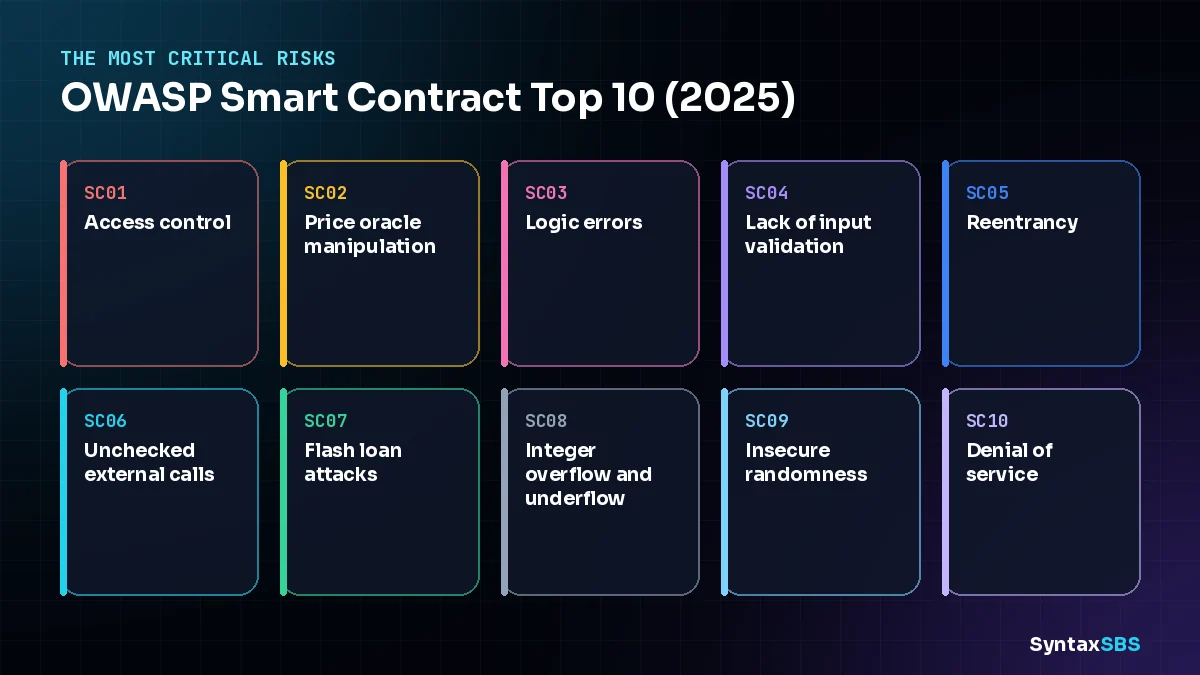
The OWASP Smart Contract Top 10 (2025)
OWASP’s 2025 list was built from real incident data, including SolidityScan’s Web3HackHub and analysis of DeFi attack vectors from 2024.
1. Access control vulnerabilities
Functions that mint tokens, move funds, upgrade contracts or change settings must be restricted to the right roles. Missing modifiers, unprotected initialisers and over-powerful admin keys are among the most damaging mistakes. Use well-tested role-based access control and protect admin keys with multi-signature wallets and timelocks.
2. Price oracle manipulation
If a contract trusts a price that an attacker can move, for example a single liquidity pool’s spot price, the attacker can borrow or liquidate at a false value. Use decentralised oracles, time-weighted average prices and sanity checks on sudden price changes.
3. Logic errors
Code that compiles and runs can still do the wrong thing: incorrect reward calculations, rounding mistakes or flawed state transitions. Clear specifications, unit tests for every rule and invariant testing catch most of them.
4. Lack of input validation
Never assume inputs are sensible. Validate addresses, amounts, array lengths and parameters, and reject zero addresses and out-of-range values explicitly.
5. Reentrancy attacks
Reentrancy happens when an external call lets an attacker call back into your contract before its state is updated. Follow the checks-effects-interactions pattern, update balances before transferring funds, and use reentrancy guards on sensitive functions.

6. Unchecked external calls
Low-level calls can fail silently. Always check return values, prefer safe wrapper libraries for token transfers, and handle failure paths deliberately.
7. Flash loan attacks
Flash loans let attackers borrow very large sums within a single transaction, amplifying any weakness in pricing or governance. Design so that no single-block state, such as a momentary pool balance, can decide prices or votes.
8. Integer overflow and underflow
Solidity 0.8 and later revert on overflow by default, which removed a whole class of bugs. Risks remain in unchecked blocks, older compiler versions and careless type casting, so review these areas closely.
9. Insecure randomness
Block values such as timestamps can be influenced or predicted, so they must not decide lotteries, games or selections. Use a verifiable randomness service instead.
10. Denial of service
Unbounded loops, reliance on a single external call succeeding, or storage that grows without limit can block a contract permanently. Prefer pull-based payments and bounded operations.
Secure development practices
- Write a specification first: define roles, invariants and expected behaviour before coding.
- Use audited libraries such as OpenZeppelin Contracts instead of writing standard components from scratch.
- Test thoroughly: unit tests, fuzz tests and invariant tests with frameworks such as Foundry or Hardhat.
- Run static analysis with tools such as Slither on every change.
- Keep contracts small and simple: complexity is the enemy of security.
- Plan upgrades and emergencies: decide in advance whether contracts are upgradeable, and how pause functions and multi-signature controls work.
- Deploy to a testnet first and monitor behaviour before mainnet launch.
- Monitor after launch with alerts for unusual transactions, and consider a bug bounty programme.
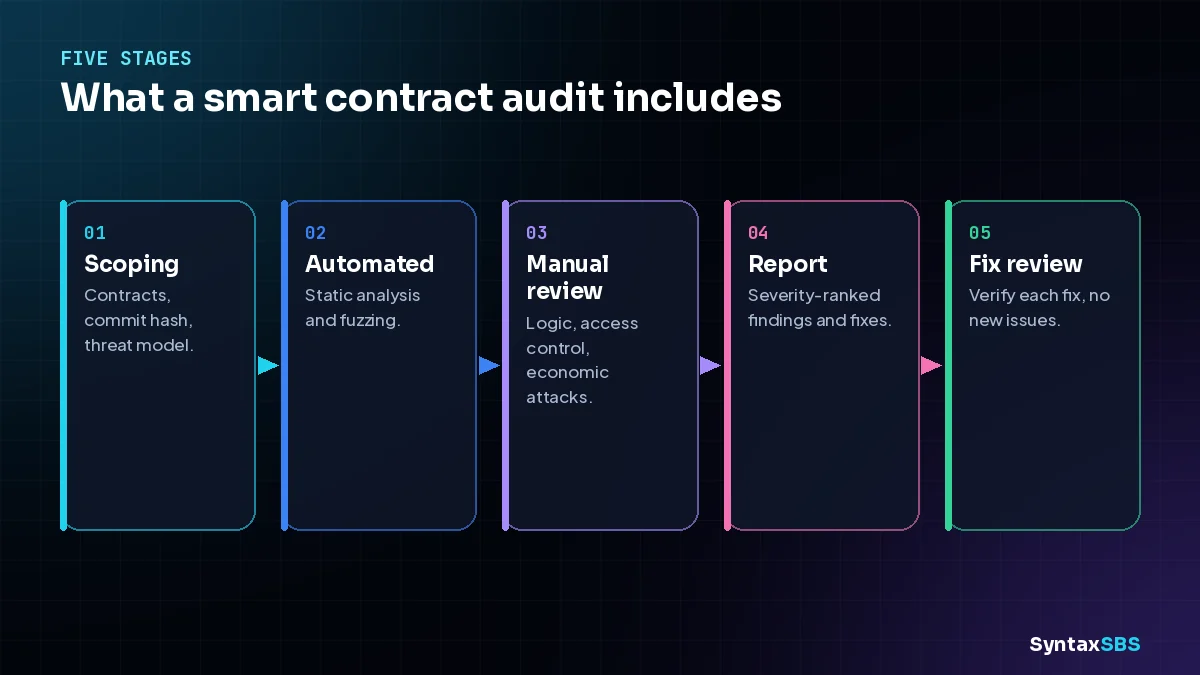
What a smart contract audit includes
| Stage | What happens |
|---|---|
| Scoping | Agree contracts, commit hash, documentation and threat model |
| Automated analysis | Static analysis and fuzzing to surface common issues quickly |
| Manual review | Line-by-line review of logic, access control and economic attacks |
| Reporting | Findings ranked by severity with proof and recommended fixes |
| Fix review | Verification that every fix works and introduces no new issues |
Security in permissioned blockchains
Enterprise networks such as Hyperledger Fabric add identity and permissions at the network level, but chaincode still needs the same discipline: strict access control, input validation and careful handling of private data. In our healthcare blockchain research, we combine attribute-based access control, trust scoring and zero-knowledge proofs so that sensitive data stays private while every action remains auditable. You can see these architectures in our portfolio.
An audit reduces risk; it does not guarantee zero bugs. Combine audits with testing, monitoring and a clear incident response plan.
Building on the blockchain? Our team develops and reviews secure smart contracts and enterprise chaincode.