KEY TAKEAWAYS
- A vulnerability assessment finds and ranks as many known weaknesses as possible, quickly and broadly.
- A penetration test goes deep: a specialist actively exploits weaknesses to prove real business impact.
- Most organisations need both: regular assessments to stay clean, and a penetration test at least yearly or after major changes.
In this guide
“Vulnerability assessment” and “penetration test” are often used as if they mean the same thing. They do not, and buying the wrong one can leave you with either a false sense of security or a large bill for the wrong deliverable. This guide explains the difference in plain language, so you can choose the right service for your risk, your compliance requirements and your budget.
What is a vulnerability assessment?
A vulnerability assessment is a systematic review of your systems to identify known security weaknesses. It relies heavily on automated scanners that compare your servers, applications and network devices against large databases of known vulnerabilities, misconfigurations and missing patches. A skilled analyst then removes false positives and ranks each finding by severity, usually using the Common Vulnerability Scoring System (CVSS).
The strength of a vulnerability assessment is breadth. It can cover hundreds of systems quickly and is affordable enough to repeat monthly or quarterly. Its limitation is depth: it tells you a door might be unlocked, but not what an attacker could reach once inside.
What is a penetration test?
A penetration test, or pentest, is a controlled, authorised attack carried out by a security specialist. The tester uses the same techniques as real attackers to exploit weaknesses, chain them together and demonstrate impact, for example moving from a low-privilege web account to customer data or administrative control.
Pentests are goal-driven and largely manual. They find issues that scanners miss entirely, such as business logic flaws, broken access control between users, and insecure workflows. Recognised methodologies such as the OWASP Web Security Testing Guide, PTES and NIST SP 800-115 keep the work structured and repeatable.
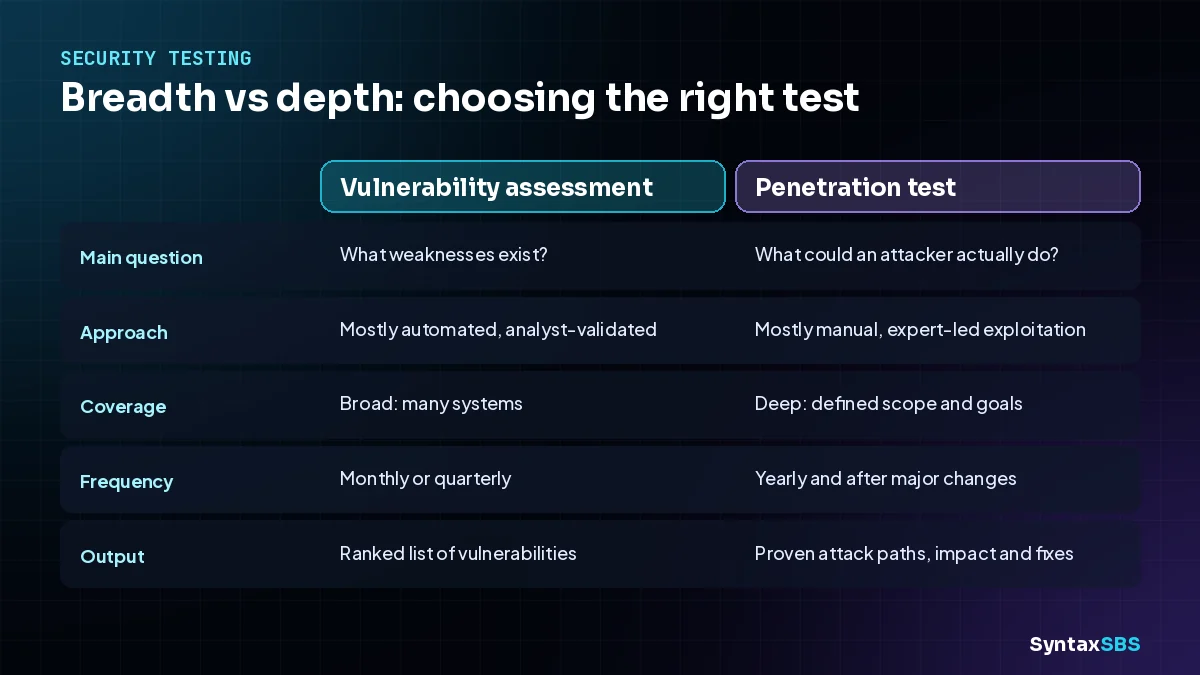
Side-by-side comparison
| Vulnerability assessment | Penetration test | |
|---|---|---|
| Main question | What weaknesses exist? | What could an attacker actually do? |
| Approach | Mostly automated, analyst-validated | Mostly manual, expert-led exploitation |
| Coverage | Broad: many systems | Deep: defined scope and goals |
| Finds logic flaws | Rarely | Yes |
| Typical duration | Hours to a few days | Several days to a few weeks |
| Recommended frequency | Monthly or quarterly | Yearly and after major changes |
| Relative cost | Lower | Higher |
| Output | Ranked list of vulnerabilities | Proven attack paths, impact and fixes |
Types of penetration testing
Web application testing
Focuses on websites and web apps: authentication, session handling, access control, injection, file uploads and business logic. The OWASP Top 10 is the common starting point, but a good test goes well beyond it.
API testing
Modern apps run on APIs, and APIs are frequently less protected than the interface users see. Testers check for broken object-level authorisation, excessive data exposure, weak rate limiting and missing authentication.
External and internal network testing
External tests target everything reachable from the internet, such as VPNs, mail servers and exposed services. Internal tests assume an attacker is already inside, for example through a phished laptop, and measure how far they can move.
Cloud configuration testing
Reviews AWS, Azure or Google Cloud environments for risky identity permissions, public storage buckets, exposed keys and weak network rules. Misconfiguration remains one of the most common causes of cloud data exposure.
Mobile application testing
Examines iOS and Android apps for insecure data storage, weak communication with the backend and flaws that can be exploited by reverse-engineering the app.
Black, grey and white box
In a black-box test, the tester starts with no inside knowledge. In grey-box testing, they receive user accounts or documentation. White-box testing includes source code or architecture access. Grey box usually gives the best value: realistic, but without wasting paid hours on discovery an attacker would do over months.

Which one do you need?
Choose a vulnerability assessment when you want regular hygiene, need a baseline before improving your security, or must show ongoing scanning for compliance. Many standards, including PCI DSS, expect recurring vulnerability scans.
Choose a penetration test when you are launching a new application, making major infrastructure changes, handling payments or sensitive data, preparing for ISO 27001 or SOC 2, or responding to customer and investor security questionnaires that ask for an independent test.
For most growing businesses, the right answer is a combination: scheduled vulnerability assessments throughout the year, plus a penetration test annually and whenever something significant changes. This keeps known issues under control while still validating your defences against a skilled human attacker.
What a good report includes
- An executive summary that a non-technical director can read in five minutes, explaining overall risk in business terms.
- Clear scope and methodology, so you know exactly what was and was not tested.
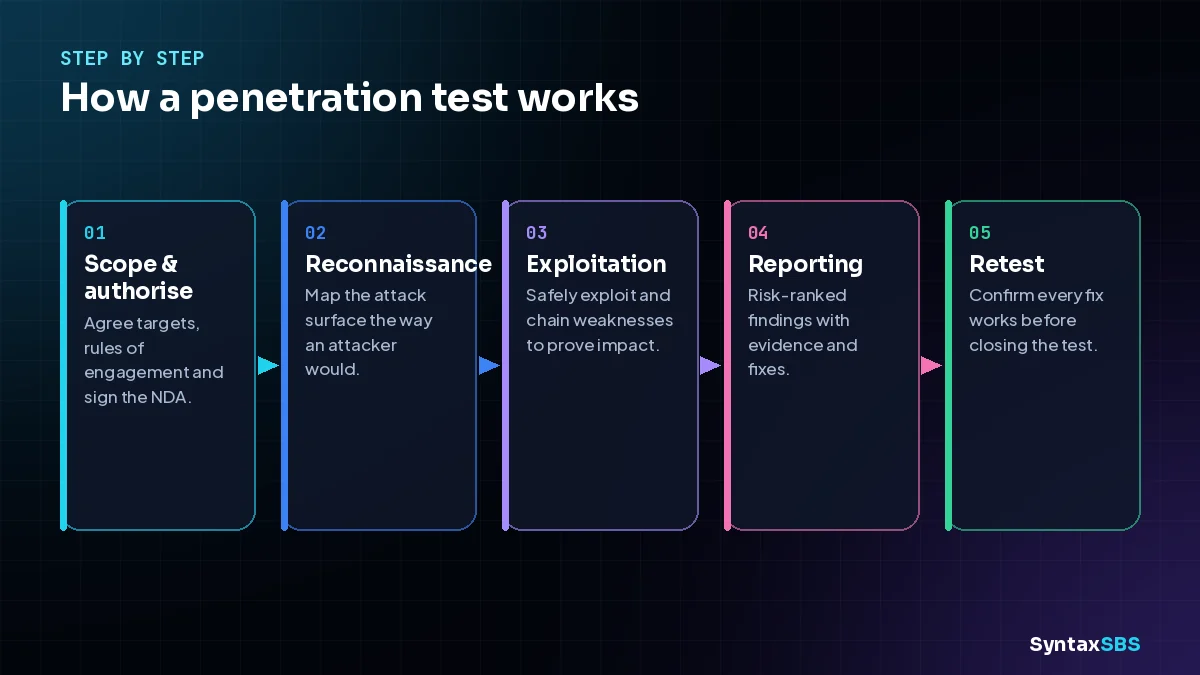
- Risk-ranked findings with severity, affected assets and evidence such as screenshots or request samples.
- Reproduction steps your developers can follow to confirm each issue.
- Specific remediation guidance, not just “apply best practice”.
- A retest to confirm fixes actually work. At SyntaxSBS, retesting is included.
How to prepare for a test
- Define the scope: which domains, IP ranges, applications and environments are included.
- Agree the rules of engagement: testing windows, forbidden actions and emergency contacts.
- Sign an NDA and a written authorisation. Testing without permission is illegal, so a reputable provider will always insist on this.
- Prepare test accounts for each user role if you choose grey-box testing.
- Take fresh backups and tell your hosting provider if their terms require notice.
- Book time with your developers after the report so fixes do not wait for weeks.
A penetration test is a snapshot in time. New code, new plugins and new staff change your risk every week, which is why continuous scanning between tests matters.
Not sure which test fits your business? We will scope it with you for free and recommend the most cost-effective option.